Everyone loves Odysseus and his epic journey home from Troy via witches, ghosts, monsters, storms, and angry gods. But what about the other heroes fighting in the Trojan War – especially on the opposing side!? There’s an intriguing imbalance when it comes to kids versions of Homeric epic (Greek) and the later epic of Virgil, a Roman (Latin) poem telling the story of the Trojan hero Aeneas as he flees his burning city and seeks a new home. There’s endless retellings of Odysseus’s adventures, but much less to be found for younger ages when it comes to Aeneas. Okay, so, he might not be as feisty and fun a hero as Odysseus (sorry Latinists), but there’s still plenty of mischief and mayhem to discover. Plus, there’s much more interesting – and increasingly important – conversations to be had about refugees and displacement, as Aeneas is forced to flee his war-ravaged and doomed city. So when I spotted Virgil’s Aeneid for Kids by Federico Corradini and Silvia Baroncelli, I knew we’d have to investigate!
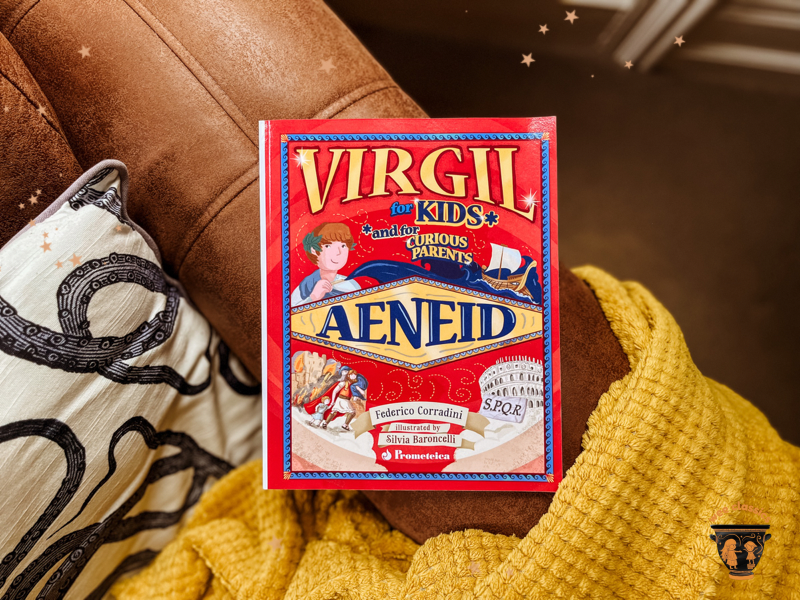
This hefty paperback takes on the challenge of retelling the whole story – all twelve books of Virgil’s original poem – in an accessible and child-friendly way. It does this by breaking down the narrative into the key components, choosing to tell twenty five shorter stories about the characters and events. I liked this approach a lot!
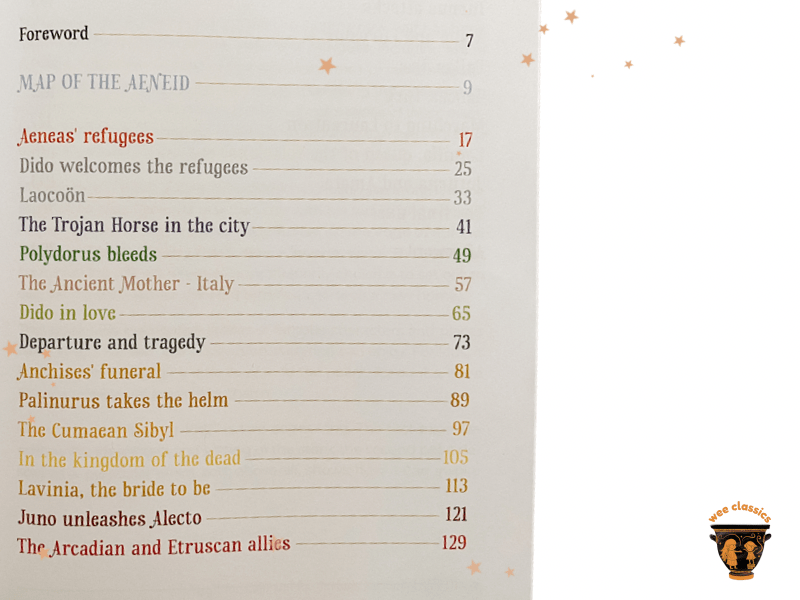
Each chunk of the story is retold over two pages – no more, no less! This means it is easy to divide and read across several days, making it ideal for reading at bedtime or across a couple of weeks as a class. Each story section then follows the same format each time: a brightly coloured title page, a relevant Latin quote from Virgil’s original with English translation underneath, a coloured illustration, the story itself, and a blank version of the illustration for children to colour themselves. It will surprise nobody that my favourite bit was the Latin quote! What a great idea for keeping a little bit of the original alive for kids!

There’s often a lot going on in the Aeneid, so having the twenty five chunks in the same repeated format is a clever way of making it a little more digestible for younger ages. The retellings are kept simple and to the point, and for the most part the language is clear; some vocabulary choices may be a little tricky for those in the KS1 range, and sometimes the clauses can get a bit elaborate – so supported reading would work best for younger ages. We found that some of the pages where the text is printed directly over the illustration can be a bit unclear depending on the design, but it wasn’t a huge issue.

Having a colouring page is a lovely idea, and a nice way of consolidating the story section that’s just been read. The 6yo was a big fan of these, though he did have to be encouraged a few times that he didn’t have to make it exactly the same as the one already in the book if he didn’t want to! Having a second illustration to colour, based on the same story section, would have been nice – but would have added a lot of extra work for the illustrator, so it’s understandable that the same one was used again. The binding is fairly flexible, so you could photocopy these pages instead if you didn’t want to colour directly on the book itself.

Each of the twenty-five story chunks has one specific illustration to go along with it, based on a key part of the story. These are always brightly coloured on the page before the story starts and always very engaging – they sometimes also mirror famous pieces of ancient art, like the picture of Laocoön and his sons meeting their terrible fate:

(plus super famous quote about Greeks bearing gifts!)
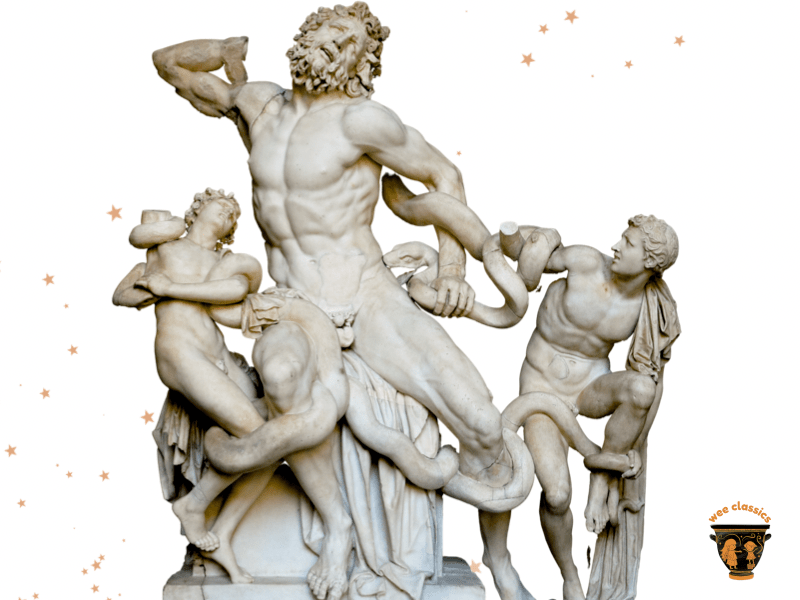
Vatican Museum
On the resources side, there’s a superb map of Aeneas’ travels at the beginning. This shows his different destinations, and is really useful to refer back to while reading each section:
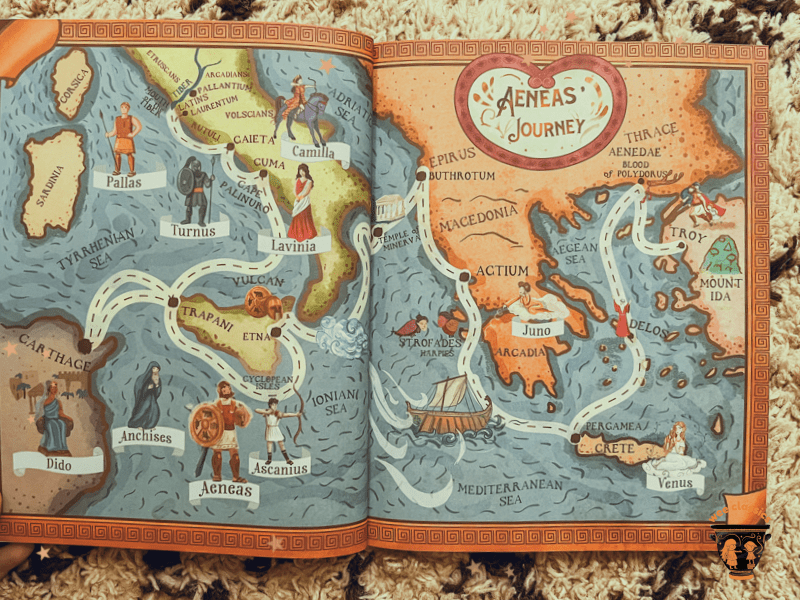
It would have been great to have a glossary at the back to help readers who might be newer to the Roman place-names, as well as Roman mythological names more broadly. Aeneas encounters so many interesting people and places, it would be great to have a glossary or ‘who’s who’ list for the keener beans to find out a bit more – obviously it’s easy to search it online, but having the info at hand (and pitched at the same level) is usually much more useful! I’d have liked a bit of phonetic help with pronunciation too, especially for names like the above Laocoön (lay-oh-koh-on). But these are all just little things: for anyone keen to start shifting the Greek/Roman epic imbalance for kids, this is a solid start!
 wee classics